Base64 does not store a character set. It only turns bytes into printable characters and restores those same bytes during decoding. Garbled text appears when the restored bytes are interpreted with a different character set from the one used by the producer.
Start with one known-good sample
Create a short value whose source text and character set are known. This separates a Base64 problem from a charset problem before production payloads add more uncertainty.
Source text: 中文编码测试:你好,ParseNest
UTF-8 Base64: 5Lit5paH57yW56CB5rWL6K+V77ya5L2g5aW977yMUGFyc2VOZXN0
Decoded as UTF-8: 中文编码测试:你好,ParseNestDecode to bytes before guessing a charset
The prefix 5Lit5paH decodes to the bytes e4 b8 ad e6 96 87. Those byte sequences are valid UTF-8 for 中文. Keep the bytes unchanged while testing character sets; re-encoding already-garbled text can make recovery impossible.
Base64: 5Lit5paH
Hex bytes: e4 b8 ad e6 96 87
UTF-8 text: 中文Compare explicit decoders in Java 8
Never rely on the platform default charset. Decode Base64 once, then construct text explicitly. In this sample the UTF-8 line is readable while the GBK line is not, proving that changing the Base64 alphabet would not solve the issue.
import java.nio.charset.Charset;
import java.nio.charset.StandardCharsets;
import java.util.Base64;

public class Base64CharsetCheck {
    public static void main(String[] args) {
        String value = "5Lit5paH57yW56CB5rWL6K+V77ya5L2g5aW977yMUGFyc2VOZXN0";
        byte[] bytes = Base64.getDecoder().decode(value);

        System.out.println(new String(bytes, StandardCharsets.UTF_8));
        System.out.println(new String(bytes, Charset.forName("GBK")));
    }
}

// First line: 中文编码测试:你好,ParseNest
// Second line: unreadable mojibake because the bytes are not GBKTrace the charset back to its source
Check the producer rather than cycling through encodings at random: HTTP Content-Type, Java getBytes calls, database connection settings, file encoding, message-queue metadata, and any gateway that converts request bodies. The component that first turns characters into bytes determines the correct decoder.
Verify the corrected path end to end
Encode the original text with the declared charset, decode it back to bytes, and compare both the bytes and final text. Then repeat the same path through the real API or file. A readable preview alone is not enough if a replacement character has already discarded data.
Original UTF-8 bytes == decoded bytes: true
Original text == decoded UTF-8 text: true
Replacement character (U+FFFD) present: false
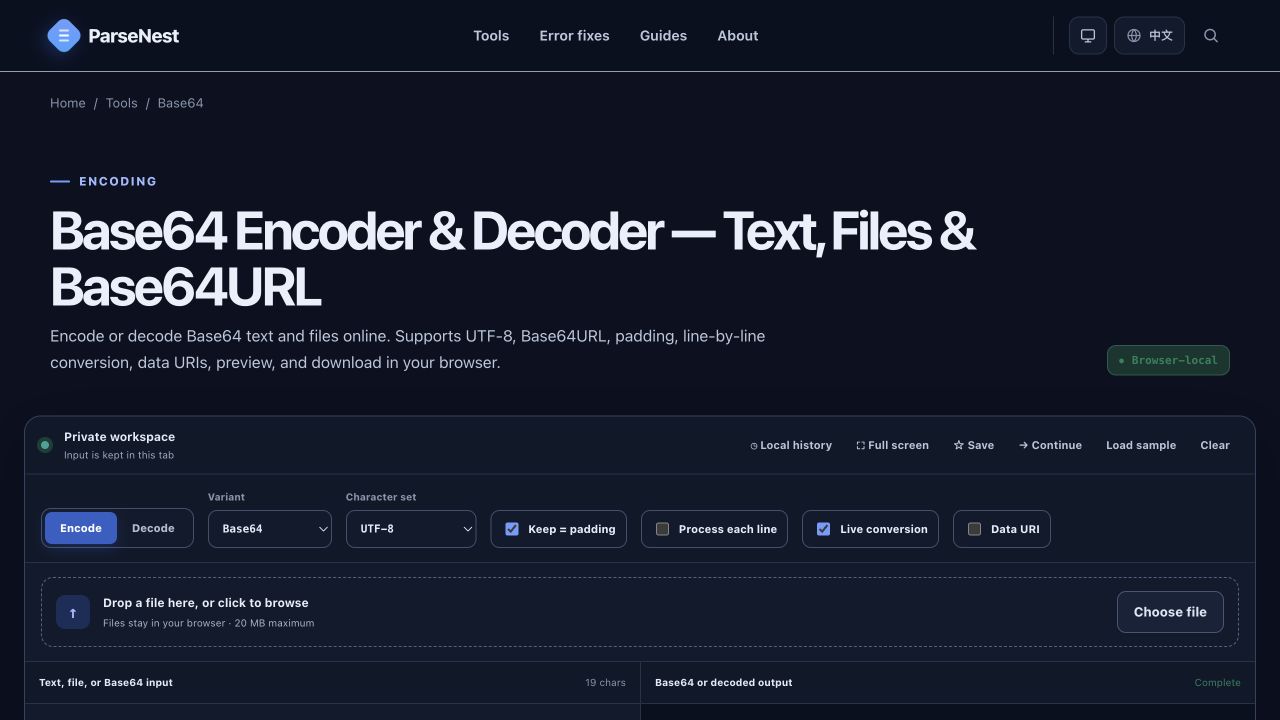
Reproduced in the ParseNest Base64 workspace
This screenshot uses the exact sample above. The tool is set to standard Base64 and UTF-8, and all processing stays in the browser tab.
Recognize the symptom before changing data
| Symptom | Likely cause | Next check |
|---|---|---|
| 5Lit5paH… remains visible | The value has not been decoded yet | Decode Base64 once |
| Text resembles ä¸æ–‡ | UTF-8 bytes were read as a single-byte charset | Interpret the original bytes as UTF-8 |
| Text contains � | The decoder replaced invalid or missing bytes | Recover the original bytes before converting again |
| Blank preview or binary noise | The payload may be a file rather than text | Inspect MIME type and download the decoded bytes |
A strict UTF-8 check in JavaScript
TextDecoder with fatal enabled throws when the decoded bytes are not valid UTF-8. That is safer for diagnosis than silently inserting replacement characters.
const value = "5Lit5paH57yW56CB5rWL6K+V77ya5L2g5aW977yMUGFyc2VOZXN0";
const bytes = Uint8Array.from(atob(value), c => c.charCodeAt(0));
const text = new TextDecoder("utf-8", { fatal: true }).decode(bytes);

console.log(text);
// 中文编码测试:你好,ParseNest- Base64 restores bytes; it does not identify their character set.
- Decode once and preserve the bytes while testing charset assumptions.
- U+FFFD replacement characters may mean information has already been lost.
- The producer's character-to-byte conversion is the authoritative source of the charset.